

Busy family life moves fast, and without the right systems in place, daily routines can unravel quickly. From cluttered entryways to forgotten schedules, a few well-chosen organizational tools can transform how a household runs — for both parents and kids.
Why Home Organization Systems Matter for Families
When a household runs on autopilot, it's usually because someone has built smart systems behind the scenes. For families with children, the challenge isn't just managing stuff — it's managing information, schedules, responsibilities, and the sheer volume of items flowing in and out of the home every day. Without structure, even the most motivated parent can find mornings turning chaotic and evenings consumed by searching for misplaced items.
Organization systems do more than reduce clutter. They create predictability, which children depend on to feel secure and capable. When kids know exactly where their backpack goes, what chores they need to complete, and where to find the week's schedule, they become more independent — and parents spend less time answering repetitive questions. A well-designed command center, for instance, can reduce daily back-and-forth by acting as the household's central information hub, where parents can simply point children for answers instead of repeating themselves (source).
Building an Entryway That Works
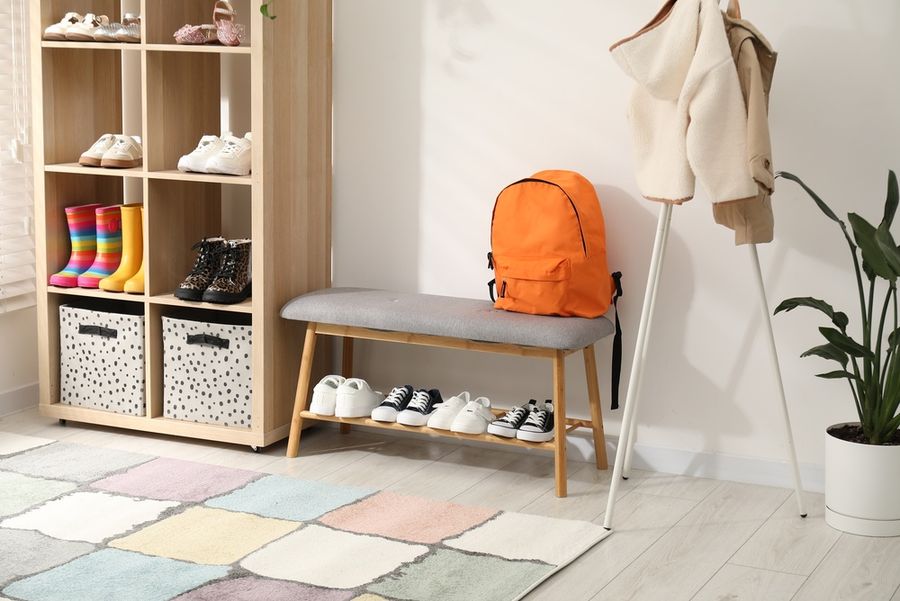
The entryway is the first and last stop of every family member's day, making it one of the highest-impact zones to organize. A dedicated drop zone near the front door or mudroom keeps floors clear and establishes a consistent routine for arriving and departing. Heavy-duty hooks rated to hold substantial weight — and designed with a double hook for both a coat and a backpack — give each family member a personal landing spot (source).
Pairing a hook system with a shoe storage bench adds another layer of functionality. Children can sit down and remove their shoes in one spot, and that same bench can serve as a staging area the evening before a school day — a place to set out supplies, bags, and anything else needed for the morning (source). Small habits like this, anchored to a physical space, are far easier to maintain than rules that exist only in someone's memory.
Family Command Centers: The Household Brain
A family command center is one of the most versatile organizational tools a household can adopt. At its core, it brings together everything a family needs to access quickly — the monthly calendar, grocery lists, meal menus, bill reminders, chore assignments, and important papers — all in one dedicated wall space (source). Rather than hunting through countertops or inboxes for information, every family member knows exactly where to look.
Command centers can be tailored to suit the household's specific needs and aesthetic. A color-coordinated setup using a whiteboard calendar, galvanized buckets for office supplies, and labeled folders for each child creates both visual order and practical function (source). For families who want each child to develop personal accountability, assigning every child their own wire basket, individual calendar, and dedicated hook teaches ownership and responsibility from an early age (source).
Chore Charts That Kids Actually Use
Getting children to follow through on household responsibilities is often more about the system than the rules. Chore charts designed with pictures rather than just words work especially well for younger children and early readers, making tasks immediately recognizable without requiring a parent's intervention. Slider-style charts — where a child physically moves a marker from an incomplete to a complete position — turn task completion into a tactile, satisfying experience (source).
The physical act of marking a task done reinforces the habit loop. Over time, children internalize these routines, requiring less prompting and fewer reminders. Pairing a chore chart with a family command center means responsibilities are always visible, expectations are consistent, and accountability becomes part of the household's natural rhythm rather than a source of daily conflict.
Meal Calendars and Schedule Tracking
Managing meals and family schedules is another area where a structured system pays significant dividends. A dry-erase family calendar mounted on the refrigerator — with sections for monthly, weekly, and daily views — gives every household member a shared understanding of what's coming up (source). Including a meal menu in the command center or alongside the calendar eliminates the daily "what's for dinner?" question and helps with grocery planning.
When meal planning is visible and accessible, families spend less time making last-minute decisions under pressure and more time executing a plan that already exists. This reduces stress, minimizes food waste, and helps children understand the rhythm of the week. Scheduling consistency, just like spatial organization, gives families the foundation to move through busy days with greater ease and fewer disruptions.
Take Command
Home organization isn't a one-time project — it's an ongoing practice that evolves alongside a family's needs. Entryway systems keep mornings running smoothly, command centers consolidate household information into one accessible place, chore charts build independence in children, and meal calendars reduce daily decision fatigue. Each of these tools works individually, but together they form a cohesive structure that supports the entire household. For families looking to reduce daily friction and build a calmer, more predictable home environment, investing in well-designed organizational systems is one of the most practical steps available.